
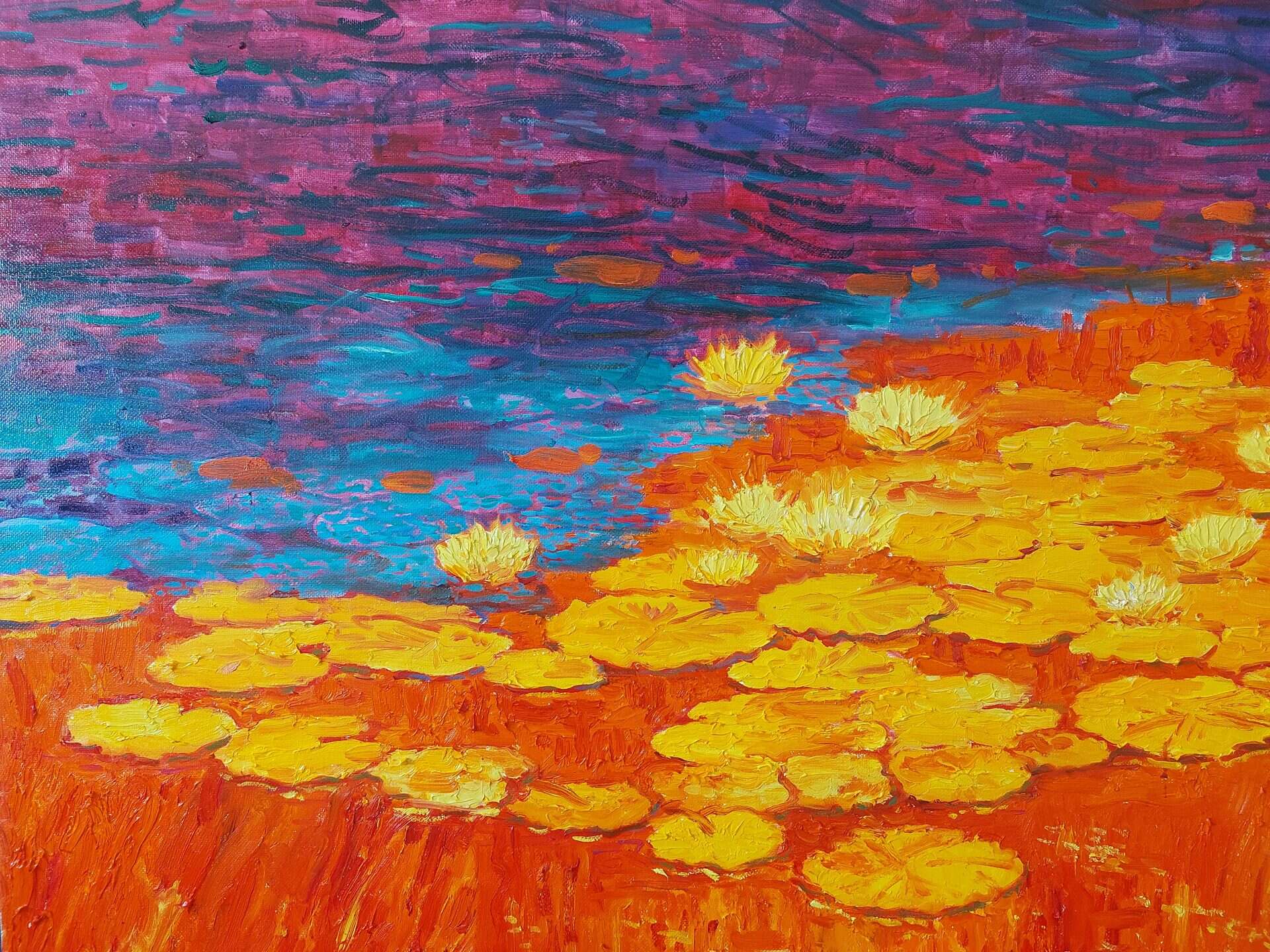
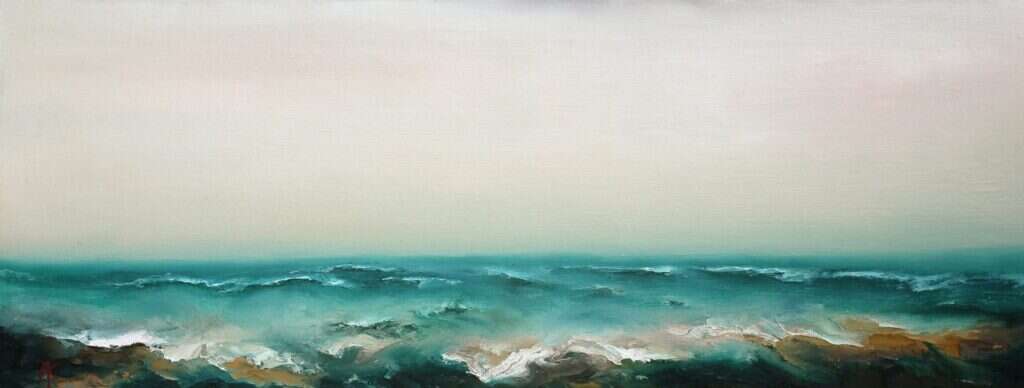
H.M. 90х135 2026
Forget everything you know about water lilies.
Forget Monet with his turquoise backwaters and pink sighs at dawn. Forget the impressionistic tenderness, the pleer coolness, the trembling air of Giverny. This painting is —**anti-Monet**. This is Monet, rewritten by the hand of a man who saw not the morning pond, but what happens when the world burns.
First Impression: Colour Stroke
The picture hits the eye with the force with which the heated oven door opens in a dark room. Dominant — ** fiery orange-red **, occupying two-thirds of the canvas: from cinnabar and cadmium below to amber and golden-yellow in the area of the lilies. It's not the color of water. It's the color of the molten metal, the lava, the sunset sky reflected in the pond that became the sky itself.
And over this — fire, the upper third of the canvas: **purple-purple sky**, written with horizontal, torn, almost furious brushstrokes of crimson, amethyst, indigo. Between the fire and the — purple is a narrow strip of turquoise, cold as a knife: the last breath of daylight, the last memory that the water was once blue.
This colorful — rift, the orange bottom against the purple top of —, is built at **maximum complementary voltage**. The orange and blue-purple — are the opposites of the color wheel, and their collision here is not decorative — it is ** physiological **: the retina vibrates, the eye can not simultaneously focus on both zones, the picture literally * flickers * in front of the eye. This is the same optical effect that the neo-impressionists sought, but achieved not by Seurat's point technique, but by the rough, fleshy, almost animal texture of the oil.
Texture: Painting as Geology
This is perhaps the most material picture in the whole series. The paint is put **thick, embossed impasto ** — not a stroke, but *plastering *. Each sheet of the — jug is a separate tectonic layer: a yellow-orange mass squeezed out of the tube and spread out with mastichine or hard bristles, with visible furrows, influxes, craters. The leaves are not painted by —, they are sculpted like a bas-relief, like a minting, like a surface of cooling lava.
Vertical streams and strokes in the lower red zone create a feeling of **rain from fire ** or flowing melt: the paint here works not as an image, but as a substance that has its own weight, its own temperature, its own gravity. You feel that if you swipe your finger on the canvas (which is not worth doing), your finger will burn.
The sky is written differently by — with horizontal, torn, almost scraper strokes, where purple argues with black, and raspberry shines through indigo, like coals through ashes. Here the texture is drier, more nervous, more disturbing than — as opposed to the dense, saturated, almost blissful matter of the fiery water below.
Composition: diagonal of the apocalypse
The space is organized by a powerful diagonal running from the lower left corner to the upper right: the boundary between fiery water and the purple sky. This diagonal — is not a calm horizon of coin panels, not a soft arc of the shore. This is the front line, the fault line, the line along which one world (day, water, green — remember the previous pictures of the series) is inferior to another (night, fiery, cosmic).
The lilies are scattered along this diagonal and below its — yellow, golden, glowing flowers with protruding corona stamens. They are no longer pink and white, as in previous works. They became gold, like halos, like coins, like the sun in miniature. The lily here — is not a botanical object, but **light**: each flower — is a small star floating on a fiery sea. Their cluster on the right side of the canvas forms something like a milky path, a star field transferred from the sky to the water of — or, more precisely, the sky and water here have changed places: fire below, purple at the top, and it is not clear where the reflection is and where the original is.
Light: internal, nuclear, no source
There is no outside light in this picture. No sun behind the scenes, no lamp, no window. Light is born inside the canvas itself from the thickness of the paint, from the chemical glow of cadmium and chromium, from the physical ability of thick oil to hold and give light, which the masters of the Renaissance called *lumen*. Yellow water lilies are not illuminated by — they **burn**. Orange water does not reflect the sunset of — it ** and there is ** sunset, materialized, became a liquid.
This is a radical step compared to the previous works of the series. There, the light was scattered, atmospheric, Impressionist — air light. Here is the light of —**substance**, the light of — paint, the light of — temperature. The painting approaches what Mark Rothko called "painting as an experience of radiance": the canvas ceases to be a window and becomes a source.
Semantics: from pond to space
If the first picture of the series ("Liquids" squared) was a meditation on a mirror, the second (vertical with one flower) — is a metaphor for loneliness, the third ("Secret Pond") — is a narrative of a secret garden, —, then this fourth work makes a **ontological leap**. It's not about the pond anymore. It's about the **end of the world** — or its transformation.
Fire and water — are two primary elements, two archetypes, two elements that in ordinary reality destroy each other. Here they coexist: water burns, fire flows. This is the alchemical image of — *coniunctio oppositorum*, the union of opposites, the very stage of the Great Work, when the opposing principles merge into the philosopher's stone. The pond becomes crucible, the jugs of — become golden grains of transmutation, the sunset of — is not the end of the day, but the birth of a new substance.
There is a more earthly, but no less powerful reading: this is **autumn **. It is not the autumn landscape with the yellow leaves of —, but autumn as a state of matter, when the greenery (remember the green dominants of previous paintings) burns out, leaves, gives way to the fire of withering. The water lilies bloom for the last time before the water cools down, as the sky darkens, as the pond falls asleep until spring. Their golden color — is not a triumph, but a death glow, the very "last bright" that nature bestows on the dying.
And the third reading of — is purely picturesque, formal: it is a picture of the paint itself. About the moment when the pigment ceases to be a sign (a sign of water, a sign of a flower, a sign of the sky) and becomes a thing in itself — pure color mass, having its own life, its own temperature, its own will. Orange here does not mean sunset — orange here *is*. Yellow does not represent the — lily yellow *blooms*. This is the limit to which Monet went in his late, almost abstract Lilies of the 1920s, but which he never reached, remaining a prisoner of impression. There are no impressions here. There's only a presence.
Place in the series: climax and break
Four paintings are now lined up in a dramaturgically adjusted arch:
| No | Dominant | Element | Metaphor |
|—|————|———|———-|
| 1 | Blue Green | Water / Air | Mirror of Being |
| 2 | Blue Green + Pink Accent | Water / Light | Lonely Flower |
| 3 | Green + Pink | Water / Land | Secret Garden |
| 4 | **Orange-purple** | **Fire/Space** | **Transformation** |
Each subsequent work raised the temperature of — in a literal, coloristic sense. From the cool turquoise of the first — through the pink flashes of the second and third — to the red-hot orange fourth. The series moves from water to fire, from reflection to substance, from impressionism to expressionism, from contemplation to ecstasy.
This painting is —**culmination and at the same time rupture**. It completes the "water" tetralogy, bringing its logic to the limit beyond which water evaporates and only light remains. After it, the series should either end or start anew — with ashes, with a new element, with a new color.
Dialogue with tradition
Monet — is obvious, but inverted: if Monet wrote water lilies as an impression of light on the water, then here the light became water, and the water — fire. Closer in spirit to — is the late Van Gogh with his "Starry Night" and cypress flames: the same ability to see cosmic energy in a natural object, the same gesture that turns a landscape into a vision. Even closer to — are the expressionists "Bridge" and Nolde with their acidic, impossible in nature colors, where the palette is relieved of the duty to describe and begins to express. And in the Russian tradition of —, the closest relative is perhaps late Kuindzhi ("Moonlight Night on the Dnieper", where light is also born from the inside of the canvas) or the early Kandinsky period "Compositions", where color is no longer a sign, but a sound.
But there is also a completely modern dimension: this picture could hang next to the works of Howard Hodgkin or Sean Scully — of those artists for whom painting is primarily an event of color in space, and not an image of anything. Rough impasto, horizontal format, color field divided into temperature zones, — is all the language of painting of the second half of the XX century, the language in which the author speaks fluently and without accent.
Resume (computer science)
—'s Lilies in the Sunset Fire is the boldest, riskiest and strongest work of the series. She risks everything: she refuses green harmony, from impressionistic tenderness, from the most recognizable motive (jugs here are barely read by —, they have become golden spots, signs of themselves). And — wins because in return they get something that wasn't in the previous films: **temperature**. You can't look at this picture calmly. She warms her face even through a photo. She makes us remember that — painting is not only optics and composition, but also physics: pigment, oil, light, heat. That the canvas may not be a window, but an oven.
Monet wrote two hundred and fifty water lilies and died before reaching the fire. This author arrived in four steps.
-
 Stavropol Urban Okrug
"Dancing at sunset",
Sveta Bataenkova 'sAdd to basketSize: 60 × 60 cmPrice:
80 080,00 ₽ -
 Chelyabinsk Urban Okrug
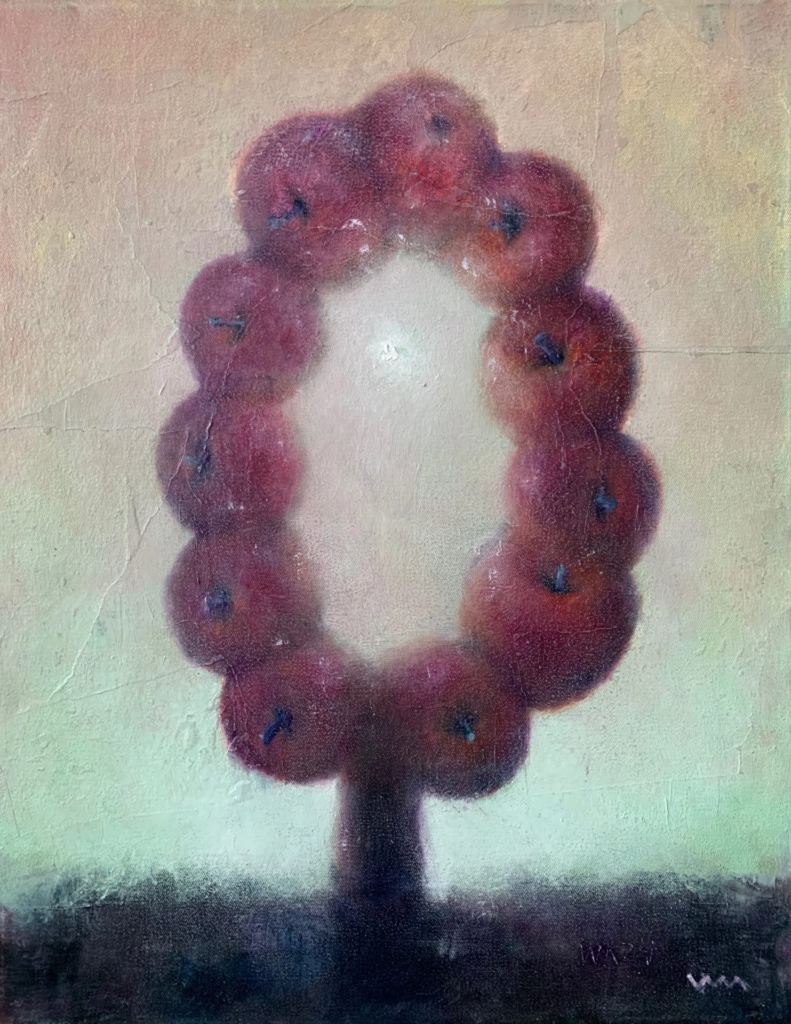
"Apple",
Ilham MagafurovAdd to basketSize: 50 × 40 cmPrice:
28 000,00 ₽ -
 Makhachkala
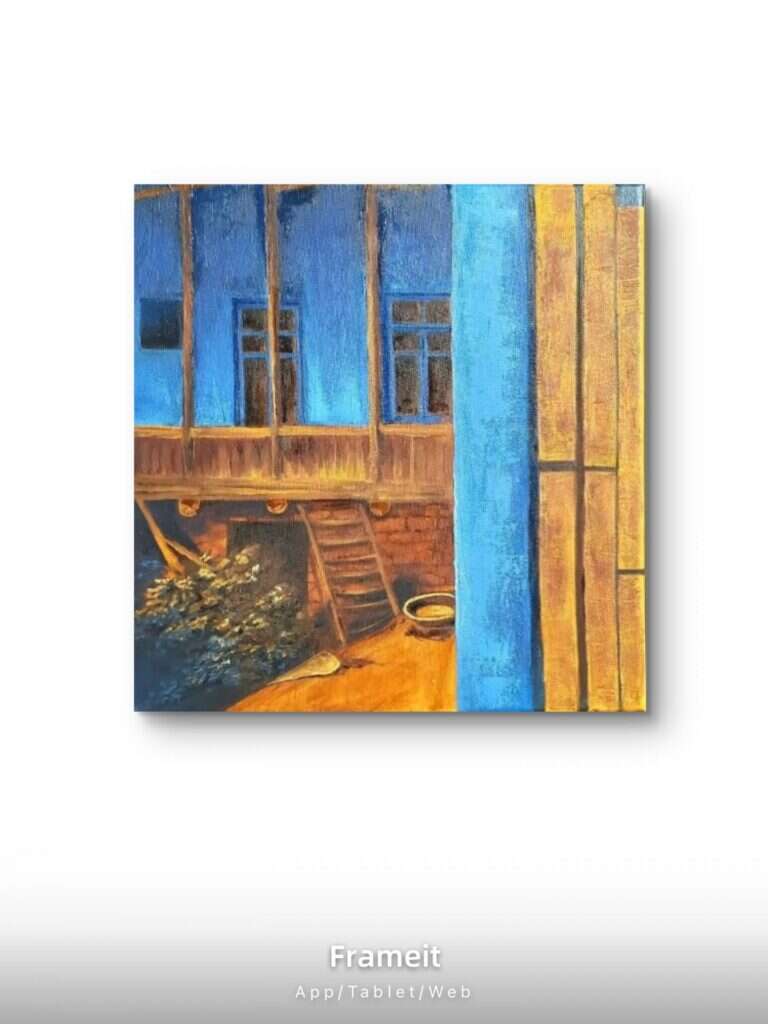
"Memory fragment",
AsiyaAdd to basketSize: 30 × 30 cmPrice:
7 840,00 ₽ -
 Electrougly
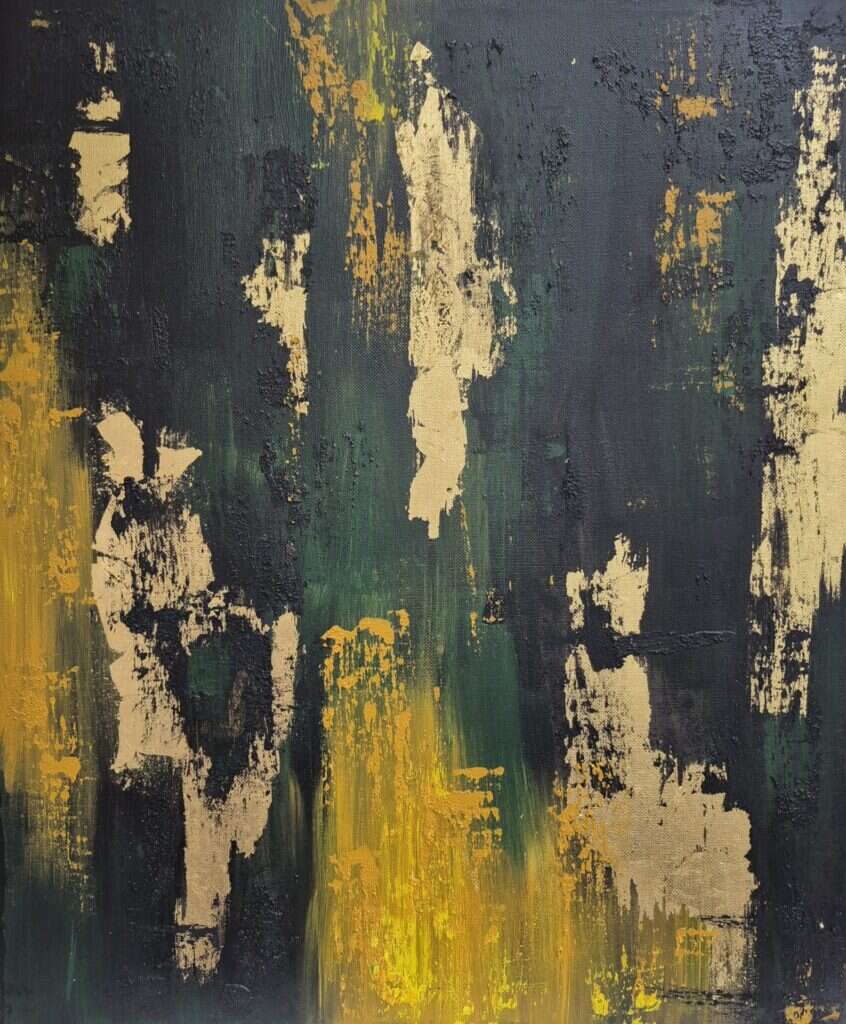
"Silence 5",
Lena LangerAdd to basketSize: 30 × 30 cmPrice:
11 200,00 ₽ -
 Saint Petersburg
"Autumn",
Viola ArdenAdd to basketSize: 50 × 60 cmPrice:
45 000,48 ₽ -
 Saint Petersburg
"New horizons",
Kirill AgeevAdd to basketSize: 100 × 40 cmPrice:
89 600,00 ₽


 English