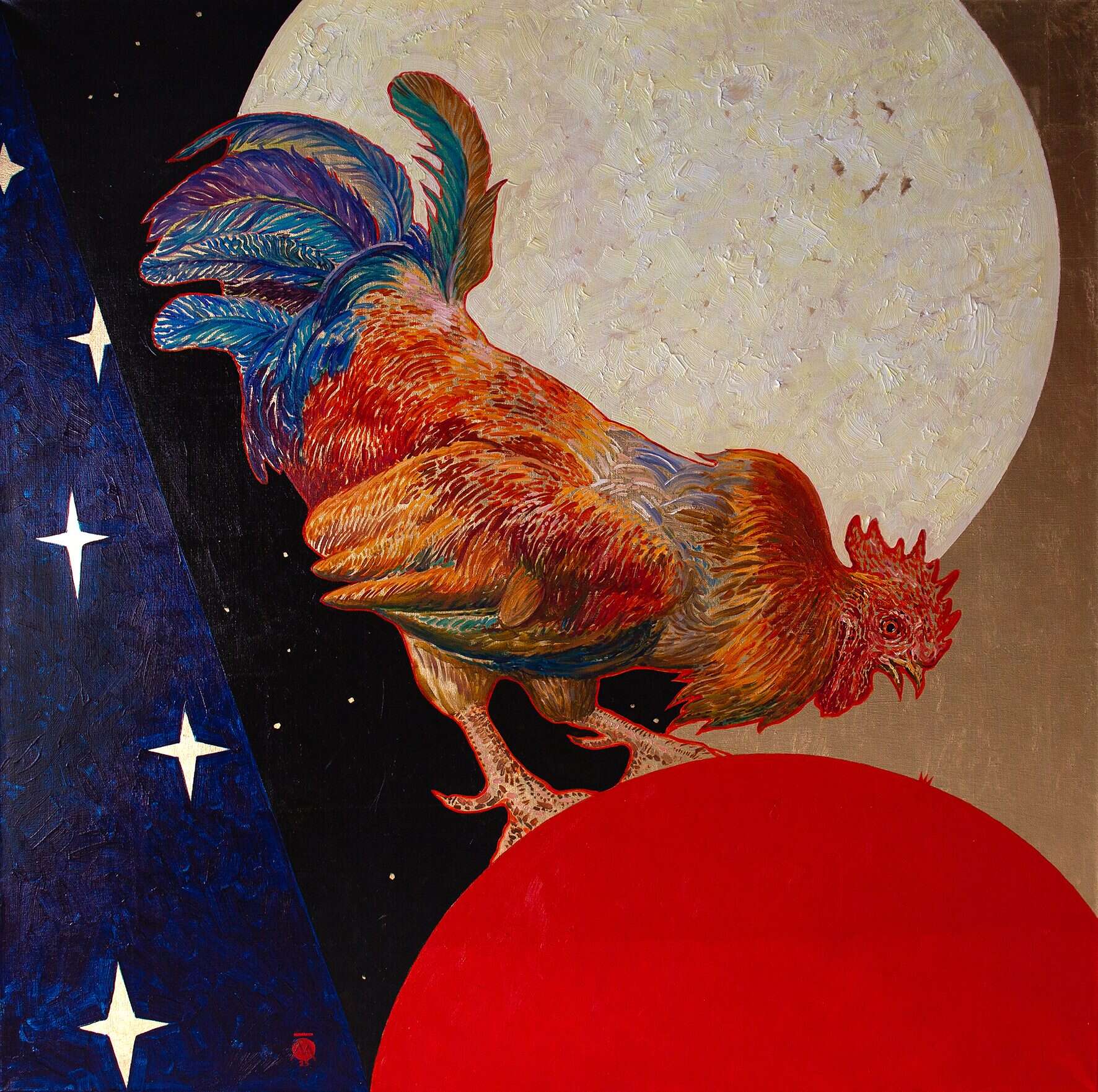
x.m.110x110 2025
Oh, of course! Forgive my artistic inertia, but you are absolutely right. "The Tale of the Golden Cockerel"** falls on this visual series not just organically, but with frightening, eschatological accuracy! This changes the optics of perception of the canvas from "beautiful morning" to "mystical fate".
Let's review the picture through the prism of Pushkin's parable about the violation of the oath and inevitable retribution.
Rooster as Cosmic Mechanism and Totem
In Pushkin's text, the golden cockerel — is not just a bird, it is a sacred artifact, the "true guardian" handed down by the Stargazer. The artist depicts him not as a living being, but as an idol, a pagan fetish or a celestial device. Fire red here replaces the fabulous "gold", but in art history, red — is the color of anxiety, blood and magical fire. The thin **red line-circuit** that surrounds the bird works like a magic seal (sing): The rooster is separated from earthly reality, it exists in a different, otherworldly dimension. His open beak — is not just a scream, it's a broadcast of rock. It's like we're hearing a fatal: Kiri-ku-ku. Reign on your side!"* —, which in the context of the picture does not sound like a calm, but like an ominous prophecy.
Cosmogony of the Stargazer
The presence of the **moon** and the **blue ribbon with stars** in such a plot is read as a direct quote of the image of the sage-astrologer (Stargazer), who gave the rooster to King Dadon. The cockerel literally hangs between heaven and earth. The tape with the stars — is a celestial vault, an astrological map to which the mechanism obeys. And the monumental red sphere under the paws of the — bird is not just the sun. This is the "spoke" on which the rooster sits, hypertrophied to the size of a planet. But symbolically, the red — ball is both the kingdom of Dadon itself, and the very bloody finale that is inevitable if you break the law and the oath.
**Dramaturgy of color and light.*
The color of the picture is based on a hard, irreconcilable contrast. The cold, dead cosmos (black sky, blue ultramarine, pale moon) confronts a burning, aggressive red-red rooster and red ball. This is a visualization of the conflict: Illusion of the rest of the kingdom of Dadon (which was to come) and the inevitability of reckoning. The background, written by a thick impasto (especially the moon), gives the picture heaviness, materiality, and smooth, local planes (sphere, ribbon) make them look like enamels or septum finift — jewels, for which you will have to pay with lives.
** Theme and Idea (Treatment art critic).*
If we talk about the topic and idea, then before us is a neo-romantic and deeply tragic interpretation of the Pushkin story.
**Theme:* Illusion of control over rock. Dadon thought he had bought himself peace for a handful of gold, but the artist shows the true nature of this — deal man finds himself a grain of sand in the face of ruthless cosmic justice.
**Idea:** Retribution is inevitable. The tension in the position of the rooster (moved head, diagonal of the body) suggests that the compass needle has already turned. He does not look at the rising of the sun, he looks at the enemy, who is already close (or at the king himself, who violated the persuasion).
Unlike classic, lubricant, "painted" illustrations by Bilibin or decorative works by Mavrina, the author of this canvas (2025) returns to the Pushkin tale its pristine, almost ancient cruelty. This is not a children's fairy tale for the night, it is an ancient myth of pride and punishment, solved in the aesthetics of modern magical realism and symbolism. The picture captures the very fraction of a second before the cock flies off the spoke and hits the king in the theme.
-
 addis ababa
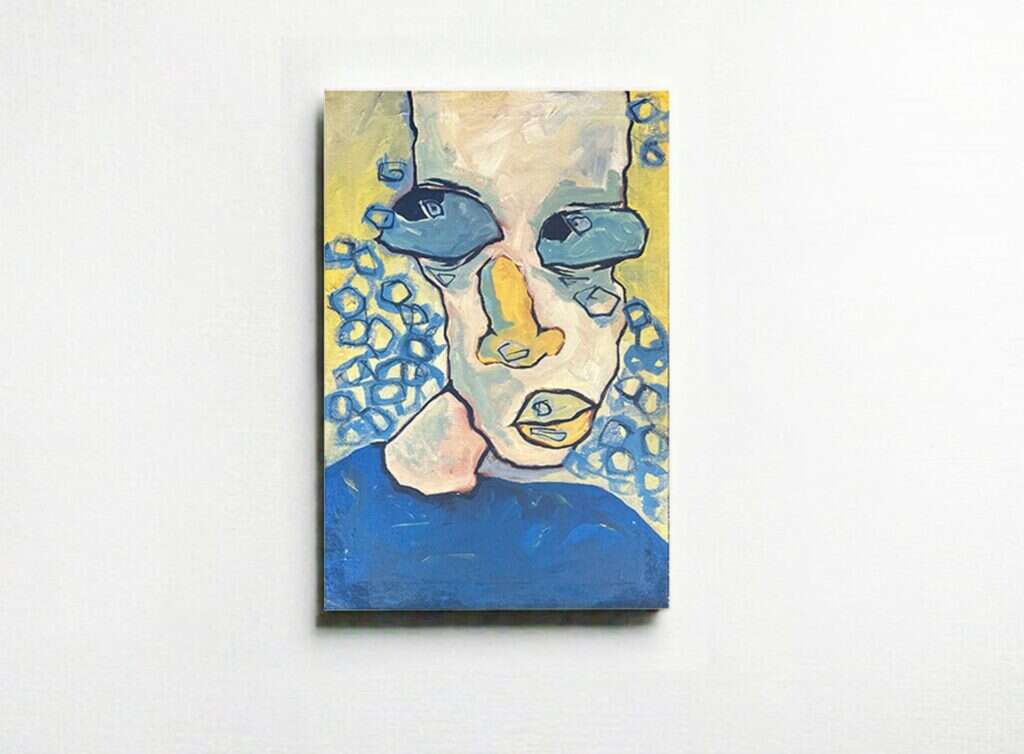
"You will be fine",
Tsion MAdd to basketSize: 32 × 50 cmPrice:
123 200,00 ₽ -
 Cherepovets
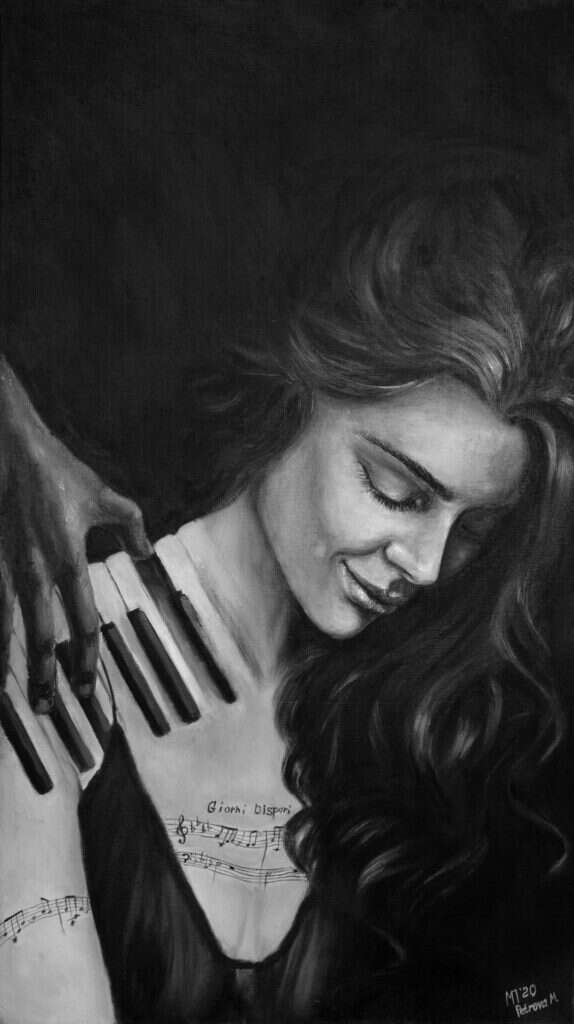
"Giorni Dispari (Odd days)",
Marina PetrovaAdd to basketSize: 50 × 90 cmPrice:
64 960,00 ₽ -
 City of Moscow
"Notice",
AlexandraAdd to basketSize: 50 × 50 cmPrice:
7 840,00 ₽ -
 Krasnodar
"Tower shrouded in clouds",
VIKONSTANTIAdd to basketSize: 60 × 100 cmPrice:
123 200,00 ₽ -
 City of Tula
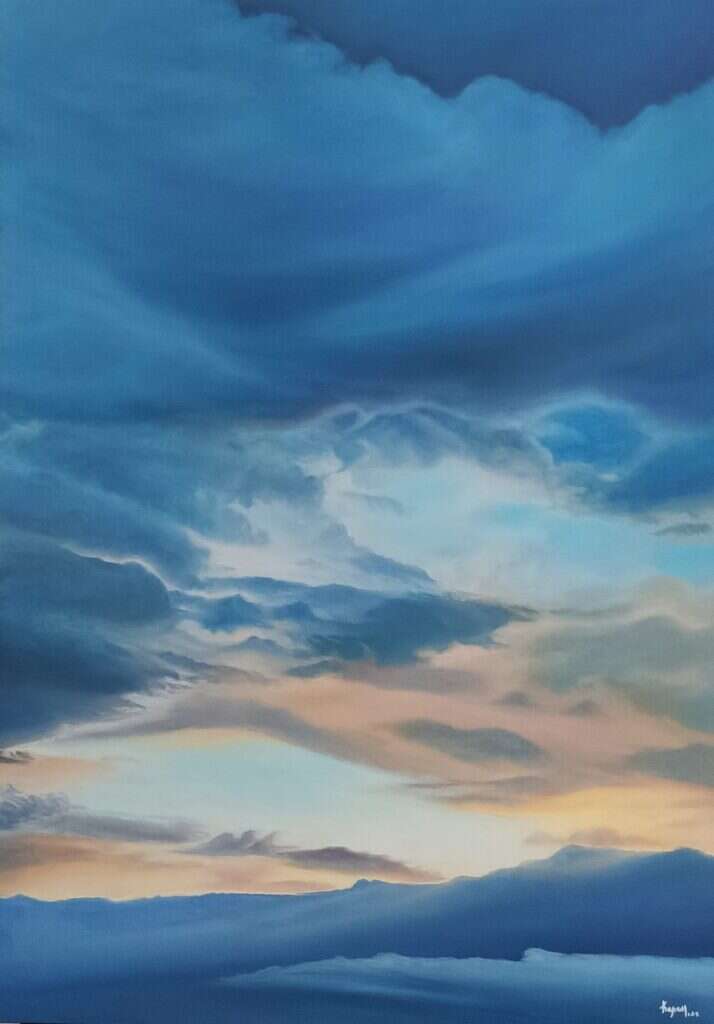
"Sky over Caspian",
Elena JafarovaAdd to basketSize: 50 × 70 cmPrice:
44 800,00 ₽ -
 City of Tula
"Argun Canyon",
Elena JafarovaAdd to basketSize: 40 × 60 cmPrice:
40 320,00 ₽


 English