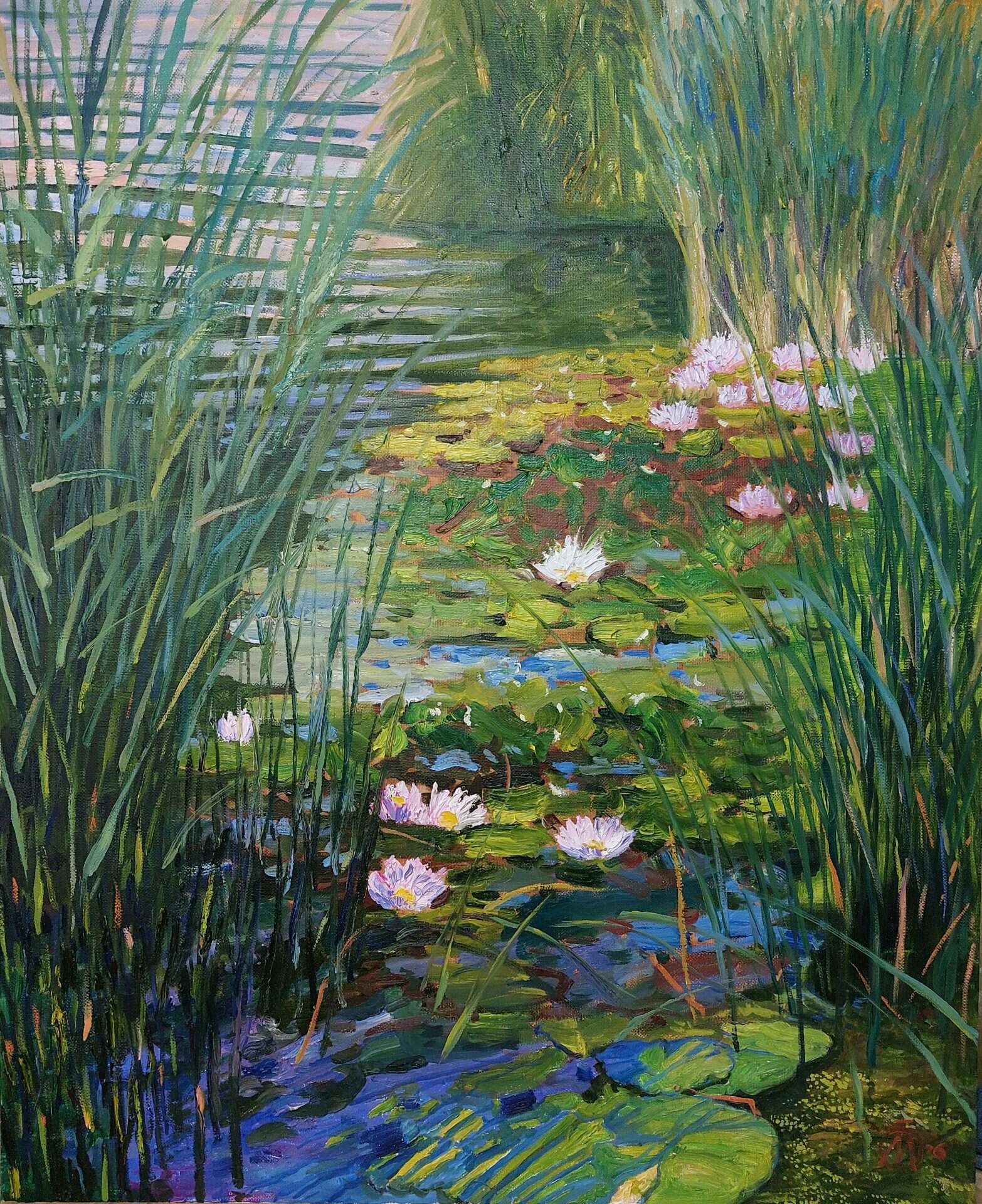
h.m. 110х90 2026
The secret pond. Oil on canvas. Vertical format**
If this author's previous Water Lilies were a *top view* of — by a demiurge hovering above a mirror of water, — is where we first descend. To the very edge. In the reeds. Where Monet never let the viewer go.
It's not an Orangerie panel anymore. This is —**peeping**.
Composition of: Voyeurism of landscape
The painting is built on a technique that in the history of painting works flawlessly since the time of the Dutch interiors of the XVII century: It's a coulisa. The thick thickets of reeds and reeds on the left and right edges of the canvas form a natural frame — dark, dense, almost theatrical. We're not looking at the pond. We're looking through the reeds in the pond. The viewer is put in the position of hiding: He squatted, spread the stems of — and froze.
This gesture changes everything. The landscape ceases to be decorative and becomes **narrative*: He has a plot, and the plot of this — is the act of contemplation. It's not about the water lilies, it's about what it's like for — to find them.
The vertical format here works like a key: it enhances the feeling of a narrow opening, a gap in the green wall through which the secret world opens. The format says: *it's not a panorama of — it's a keyhole*.
The space is: Three Planes and One Infinity
The space is organized into three clear plans going deep:
**First plan** — reeds and near water. Dark, saturated, almost black and green with purple reflexes. The stems are painted with long, whipty, vertical strokes — each stem is individual, each has its own slope, its own thickness, its own character. It's not a — background, it's a portrait of thickets. At the bottom, at the lowest edge, the water is thick, dark, blue-purple, with orange — sparks reflections of stalks? fish? autumn leaves at the bottom? Uncertainty is intentional.
**Second plan** — meadow water lilies. This is where the painting blossoms. Pink, purple, white flowers are scattered on the green carpet of leaves with the generosity with which nature scatters the stars across the — sky without symmetry, without a plan, but with an unmistakable sense of rhythm. The white pitcher in the center of — is a quiet tuning fork, a point of absolute rest amidst the pink bustle. The leaves are written with a wide, confident flat — impasto, relief, materiality. You feel their weight, their waxy surface, their coolness.
**Third Plan** — distant water and its reflections. And here is where the most interesting thing happens: horizontal stripes of pink, lilac, silver — is a reflection of the sky in the water, but written in such a way that it is read simultaneously as a reflex, and as an abstract lattice, and as a hint of a certain architecture — bridge? gazebo? garden fence? This — ambiguity is a conscious quote from the late Monet, where the reflection of the Japanese bridge in Lilies (1899) dissolves into pure color vibration. Here the author does the same: The distant plane ceases to be an image and becomes a ** state of light **.
—
The coloring is: Green Symphony with Pink Counterpoint
The dominant picture of — is green in all its forms: From the almost black malachite of the reeds to the poisonous yellow lime of the illuminated leaves, from the turquoise reflex in the water to the olive shadow under the flowers. This green is not as a color, but as a ** habitat ** — total, all-consuming, lively.
And in the midst of this green totality, — is pink. Not screaming, not aggressive, but exactly the pink that real water lilies bloom at dawn: pale, slightly purple, with a yellow eye of the core. Pink here works like a soloist's voice in the choir: he doesn't interrupt the greens of — he makes sense of it. Without pink flowers, the green mass would be just thickets. It becomes a garden with them.
The blue and purple in the — water is a complementary answer to the green, the same vibrating contrast on which all impressionistic optics rests. But here it is not decorative — it creates depth, coolness, the feeling that the water is *real *, that you can put your hand in it.
The texture of: Two Languages of the Same Picture
The author owns two fundamentally different manners of writing and freely switches between them within one canvas:
**Kamish** — is a linear, graphic, almost calligraphic smear. Long, fast, confident strokes, each of which — separate stem. Here the painting approaches the drawing, to the eastern carcass, to the very "single breath" (ichi bi), about which Chinese theorists wrote. The reeds are written by *hand movement* — you see the artist's gesture, his wrist, his speed.
** Lilies and water** — stain, mass, impasto. Here the swab is short, sculpting, mosaic. The leaves and flowers are sculpted in paint as a — sculpture voluminously, tangibly, with shadows and highlights. Water is dialed in small cells of color, like the smalt of a Byzantine mosaic, — each smear catches its own shade of light.
This contrast of the two textures — linear and spotted — creates within the picture tension that does not allow it to become just a "beautiful landscape". — reeds are energy, movement, wind. — water lilies are peace, flowering, silence. The picture breathes between these two poles.
The light is: Dispersed, all-pervading, without source
Like Monet, there is no light source in the painting. No sun, no shadow from the tree, no direction of the beam. Light exists as **property of air** — it is scattered, soft, all-pervading. It does not fall on — objects; it *comes from them*. The leaves glow from the inside, the flowers flicker with their own pink phosphorus, the water stores the entire spectrum of the sky.
The only hint of the direction of — is a slight illumination in the upper left zone, where a pink-silver sky breaks through the reeds. It's not the — sun, it's more of a memory of the sky, its echo in the water. The picture lives in the eternal twilight of — white day at a time when the light is no longer sharp, but not yet evening, when everything is still illuminated and nothing casts a shadow.
Semantics of: Garden as a state of mind
If the first picture of the series ("Liquids" in square format) was a meditation on the theme of the mirror — reflection, doubling, illusion, — and the second (vertical, with one flower) was a metaphor for loneliness and glow, —, this third work says something else. She's talking about the secret.
The pond here — is not a decorative pond in the park. This is a wild, overgrown, half-hidden corner, where the path does not lead. — reeds are a guard, the border between the world of people and the world of water. To see the water lilies, you need to *climb* — spread the stems, soak your legs, disturb peace. The painting rewards this effort: Behind the green wall opens a blooming world that exists regardless of whether you look at it or not.
In this sense, the work continues the great romantic tradition of the "secret garden" of — from the Bosch thickets to the symbolist grottoes of Redon and further, to the modern ecological consciousness, where wildlife is valuable precisely because of its inaccessibility. But here there is neither Redon's mysticism nor —'s moralizing just pure, almost childish surprise: Look what's behind the reeds.
The signature in the lower right corner of —, a red autograph barely noticeable among —'s green strokes, puts an end to: the artist was here, he found this place first, and now shares the find with us.
Place in the series and in the tradition
The three "lilies" of this author line up in a meaningful trilogy:
| No | Format | View | Metaphor |
|—|———|———|———-|
| 1 | Square | Above, Front | Mirror of Being |
| 2 | Vertical | Top Diagonal | Lonely Flower / Glow |
| 3 | Vertical | Through the Reeds, Inside | Secret Garden / Opening |
Each of the following works deepens the optics: From contemplating the surface of — to searching for the depth of — to penetrating the veil. This is not a series of copies of a single — motif, but an exploration of a single theme in three different ways of seeing, which is, in fact, the essence of the impressionist method brought to its logical conclusion.
The dialogue with Monet here is obvious, but not imitative: The author takes from Monet not a motive and not a palette, but the very ** idea of seriality ** — the idea that one object (pond, lily, reed) is inexhaustible, that each new approach to it gives rise to a new picture. Monet wrote two hundred and fifty Lilies and did not exhaust the topic. This author seems to be just beginning.
** Summary **
"Secret Pond" — is the most mature and most ambitious work of the series. It combines the decorative saturation of the impressionist color with the narrative tension of the symbolist composition, the linear energy of Eastern calligraphy with the material density of the European impasto, the peace of flowering with the anxiety of peeping. It's a painting that doesn't just depict the — pond it makes the viewer *find* it. And in this act of finding —, its main, inalienable value.
-
 Krasnodar
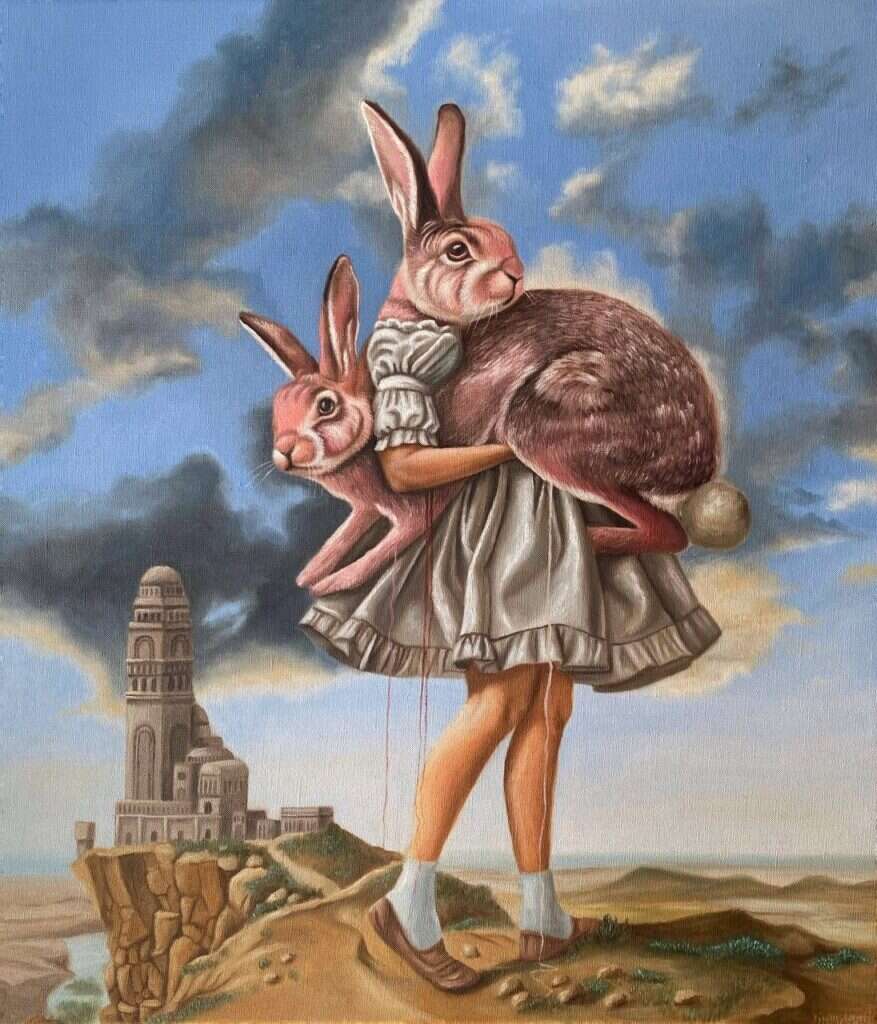
"Double",
VIKONSTANTIAdd to basketSize: 60 × 70 cmPrice:
156 803,36 ₽ -
 Saint Petersburg
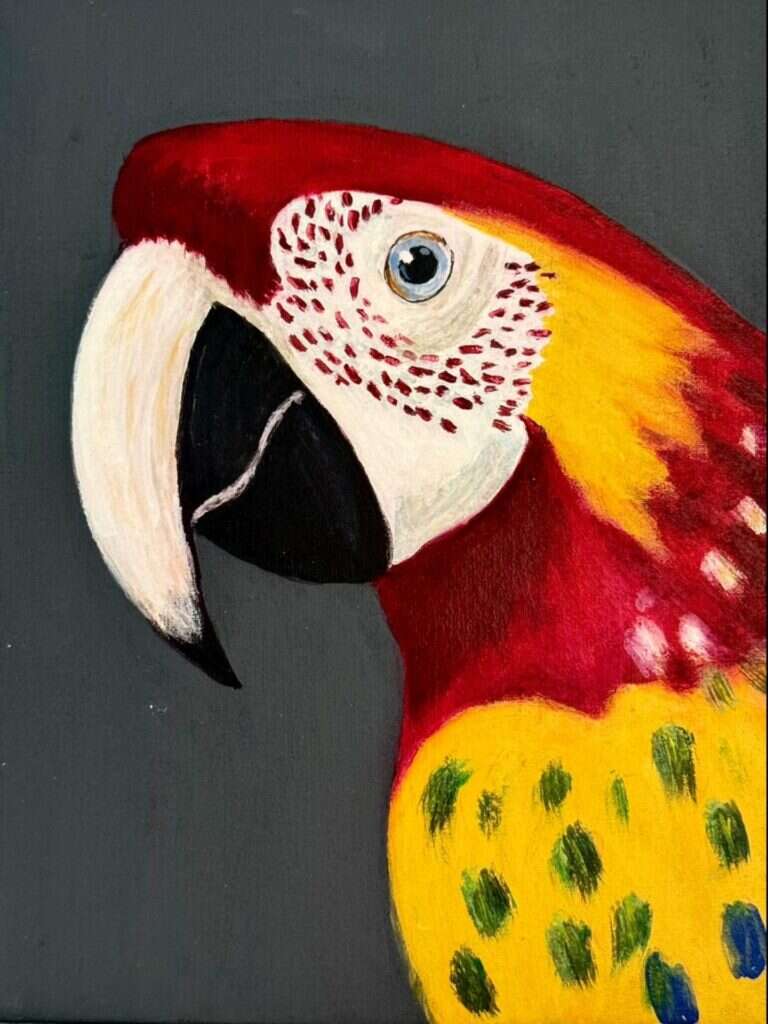
""Scarlet temperament"",
by Kate Kommer (Kate Kommer)Add to basketSize: 18 × 24 cmPrice:
8 700,16 ₽ -
 City of Moscow
"Whisper",
Olga KrylovaAdd to basketSize: 60 × 80 cmPrice:
28 000,00 ₽ -
 Electrougly
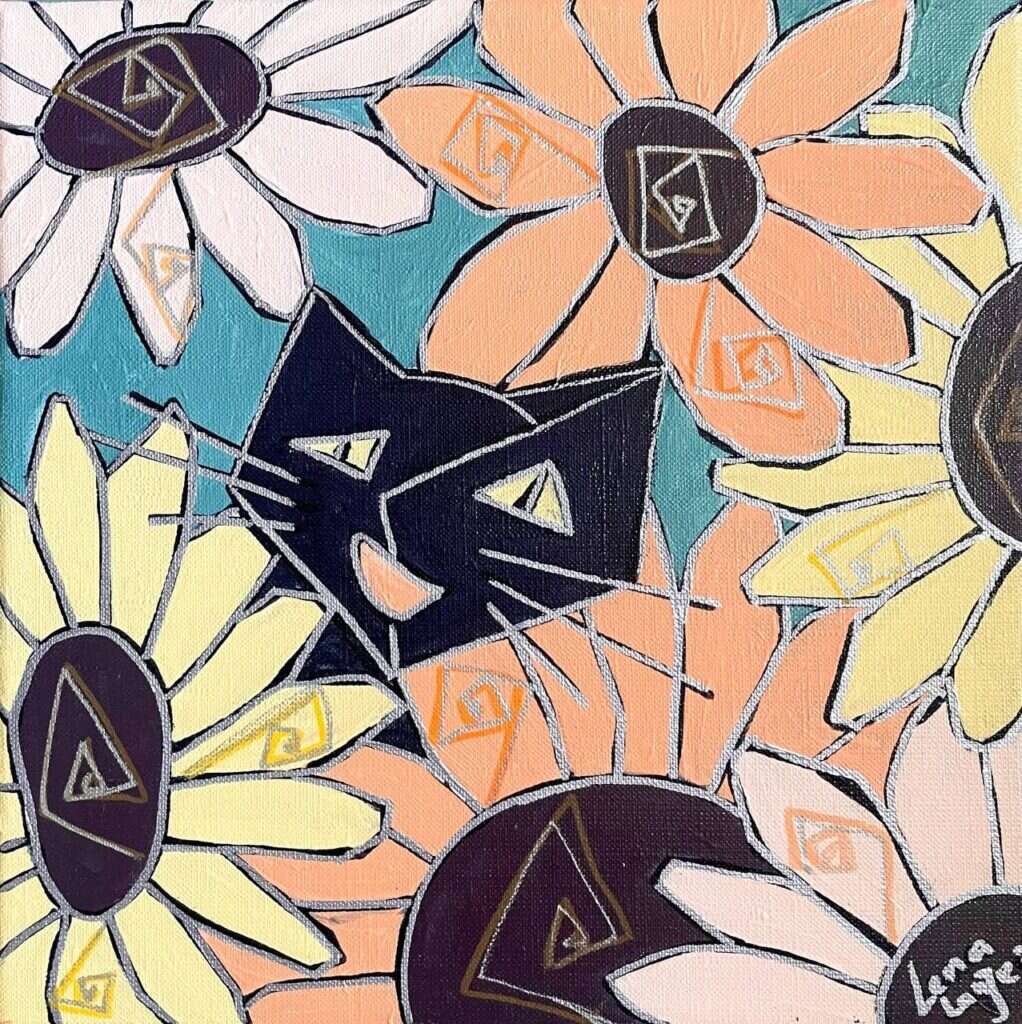
"Through sunflowers",
Lena LangerAdd to basketSize: 40 × 40 cmPrice:
17 920,00 ₽ -
 Saint Petersburg
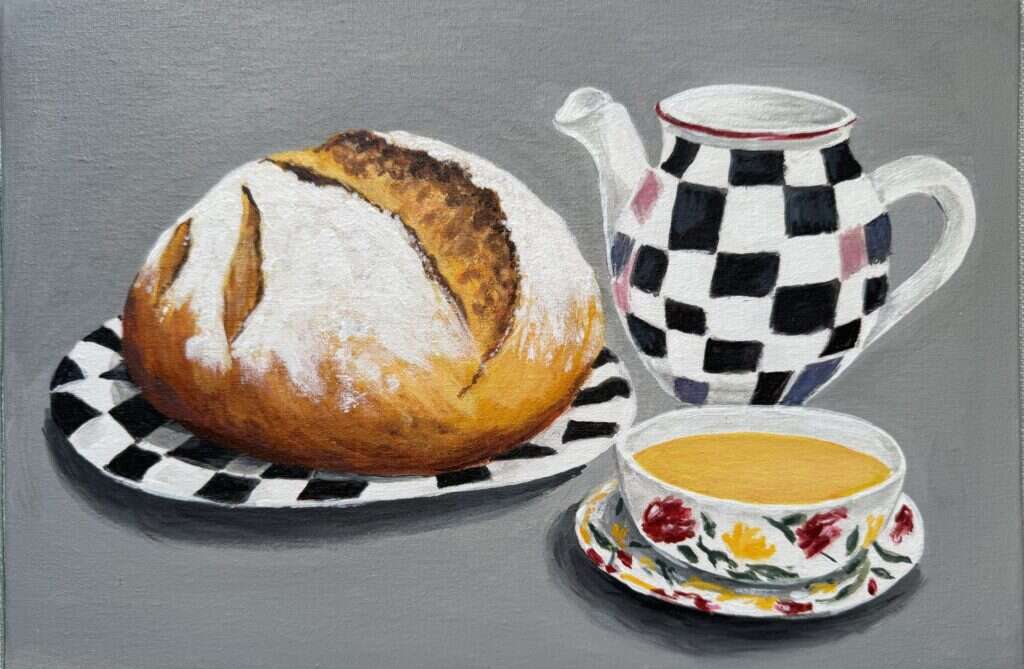
""Still life with bread, tea and ceramic jug"",
by Kate Kommer (Kate Kommer)Add to basketSize: 30 × 20 cmPrice:
12 999,84 ₽ -
 Makhachkala
"ETHNO FLOW: AMBER",
Magomedova ZaremaAdd to basketSize: 70 × 10 cmPrice:
56 000,00 ₽


 English