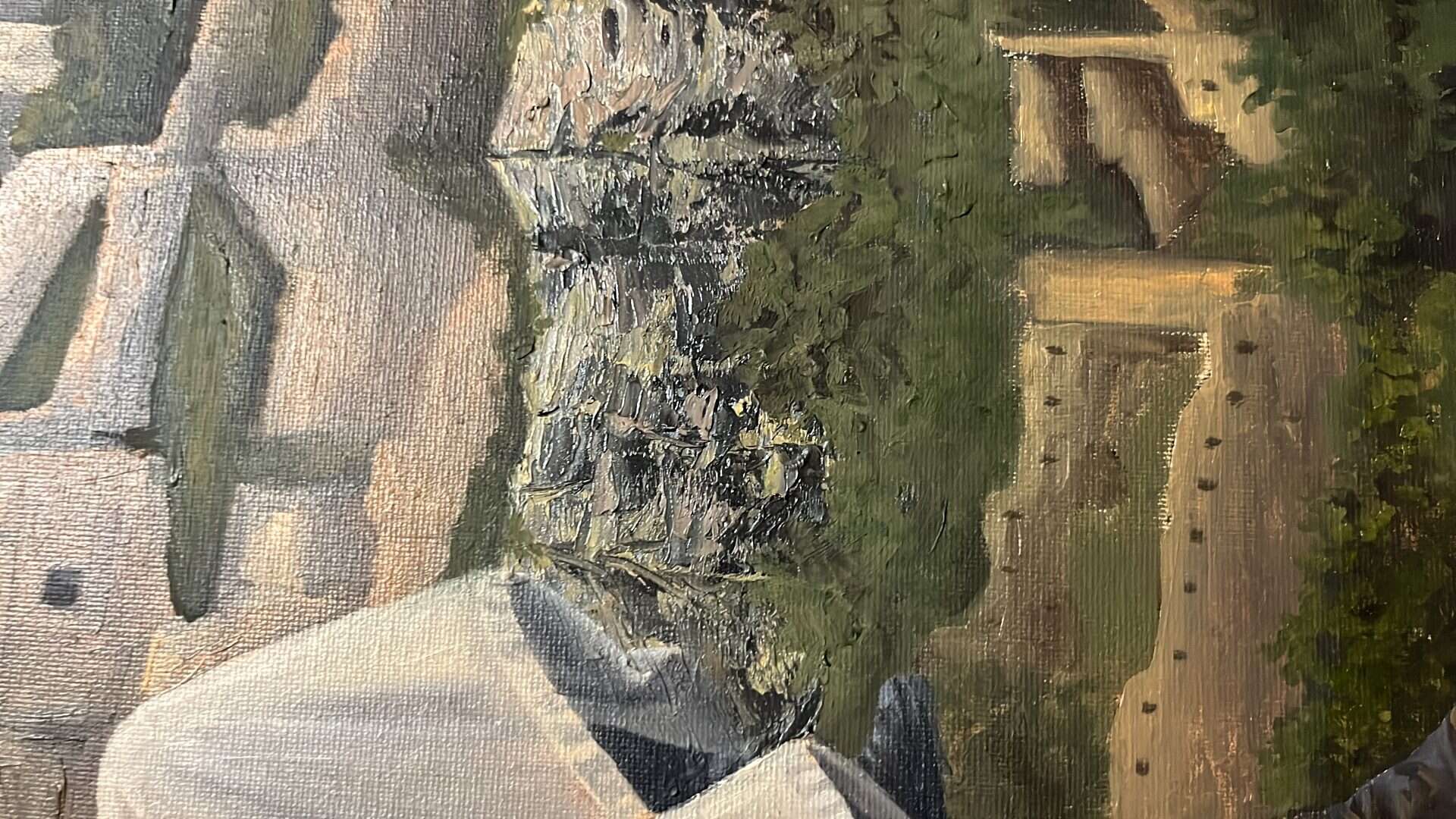
Mixed technique: sfumato, fluting, semi-dry smear, glazing. Canvas on the subframe 50/70, oil, 14.08.2026.
He survived betrayal, fear and the rift between the two worlds. But even among the ancient stones he could not find peace.
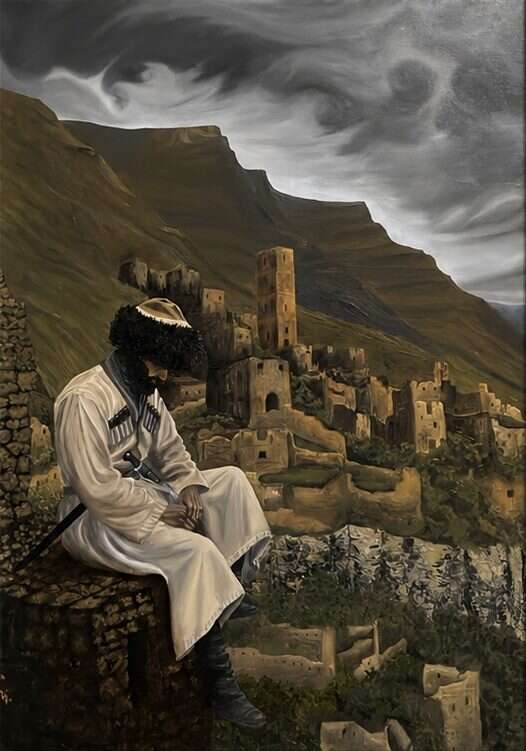
On the ruins of Kahiba sits Haji Murat, the naib of Imam Shamil. Before him is —'s lived life, behind —'s past, from which it is impossible to free oneself, and ahead is —'s unknown, in which everyone can turn out to be an enemy.
He knows the value of trust. Knows how easily suspicion turns into a sentence and how dangerous it is to find yourself between those you serve and those you seek salvation from. His return to Shamil does not erase the past. It only increases the internal tension of a person who is forced to live in the shadow of his own decisions, other people's suspicions and the constant expectation of death.
In this work, Haji-Murat is depicted not in the midst of a battle or at a moment of historical triumph. He's the only one. His bent head and immobile figure speak of an inner gravity that cannot be shared with others. Around the ruined towers of Kahiba — stands a stone memory of a world where generations lived, struggled and disappeared, leaving behind only traces of their existence.
But the look of the sky reveals another story.
In the clouds appears — skull ghostly reminder of death, which did not bring final liberation.
The name "Before the Last Light" denotes a moment on the border of existence and extinction. This is the last inner conversation of a person with himself, when it is no longer possible to change the past, but it is still impossible to stop thinking about what it means.
Here, the ruins become a memory, the — Mountains are witnesses, and the skull in the — sky is a sign of destiny that continues to disturb the living.
This is a picture of a man who sought salvation in life, but whose story did not end even after death.
The last light touches the stones. But peace remains unattainable.






 English